14 de octubre de 2026October 14, 2026 · Agnes Chocolatier Agroforestal
Here When I Got Here
Criollo, terroir, and the complexity of real chocolate.
I sat down to adapt, for the attention span of the internet, a chapter about terroir in chocolate from a book I’m working on explaining the philosophy behind Agnes and our traceability project that provides context to our claims. But another, and I think more interesting, thing came to mind, and that is the very concept of criollo chocolate itself, which I think is actually more illustrative of the flavor of place, especially in the context of cacao, which, being highly heterozygous,¹ produces an extremely wide range of effects when bred by informal, traditional or artisanal methods.
The terroir chapter is a good chapter, this is an exercise in false humility. It has a Burgundian monk, an illustrative study from Trinidad, and a confident argument that place is an ingredient that I can prove in a tasting. It will still be there next week. The problem is that every time I worked on it, I kept thinking about a conversation I’ve had, in one form or another, more times than I can count since I started working with cacao in Colombia:
I ask what the trees are. The farmer says criollo. I ask how he knows. And he looks at me the way you’d look at someone who asked how you know your grandmother is your grandmother.
That look is what real chocolate, chocolate de verdad, is all about.
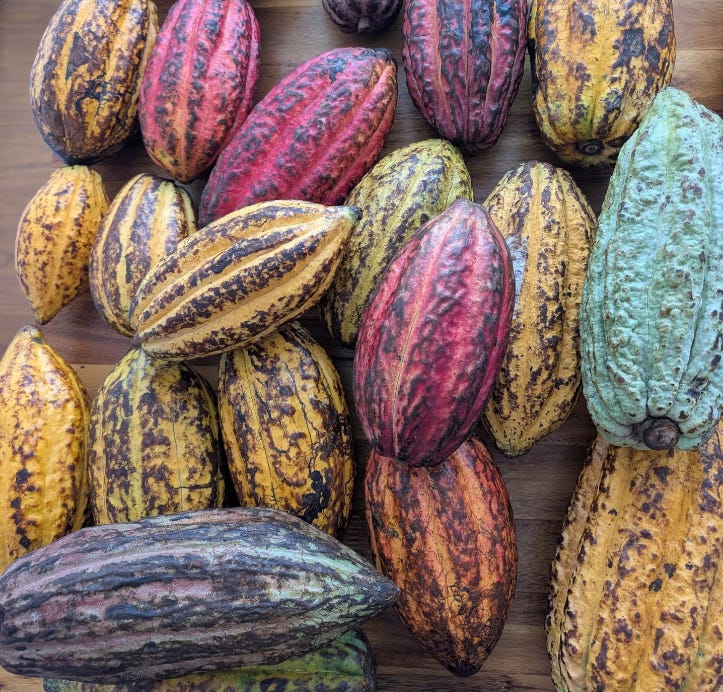
A word about the word
Before criollo was a tree, it was a person. In the Spanish colonies a criollo was someone of European parentage born on this side of the Atlantic: from somewhere else by blood, from here by birth. The word was about belonging, and it was never neutral. It sorted people.²
Its opposite, for our purposes, is forastero: the outsider, the hermit who lived alone in the woods.
At some point colonial cacao planters, mostly in Venezuela as the story is usually told, borrowed this pair of words for their trees. The old trees, the ones with the pale, almost white beans and the soft, low-bitterness flavor profile that the market paid for, were criollo. The hardier purple-beaned trees that came later, out of the Amazon, were forastero. Add a third word, trinitario, for the hybrids that came out of Trinidad where the two met, and you have the three-family system that every chocolate book printed in the twentieth century taught you, and that a surprising number still do.
Notice what has happened here: A word that meant born here, from elsewhere got pinned on a tree that was, as it turns out, exactly that. Which is either a coincidence or a most curious accident in the history of agricultural vocabulary.
Notice also that the original definition was never genetic. Nobody in 1750 knew what a gene was. Criollo described what a tree looked like, what its beans tasted like, and how long it had been around.
Criollo, the genotype
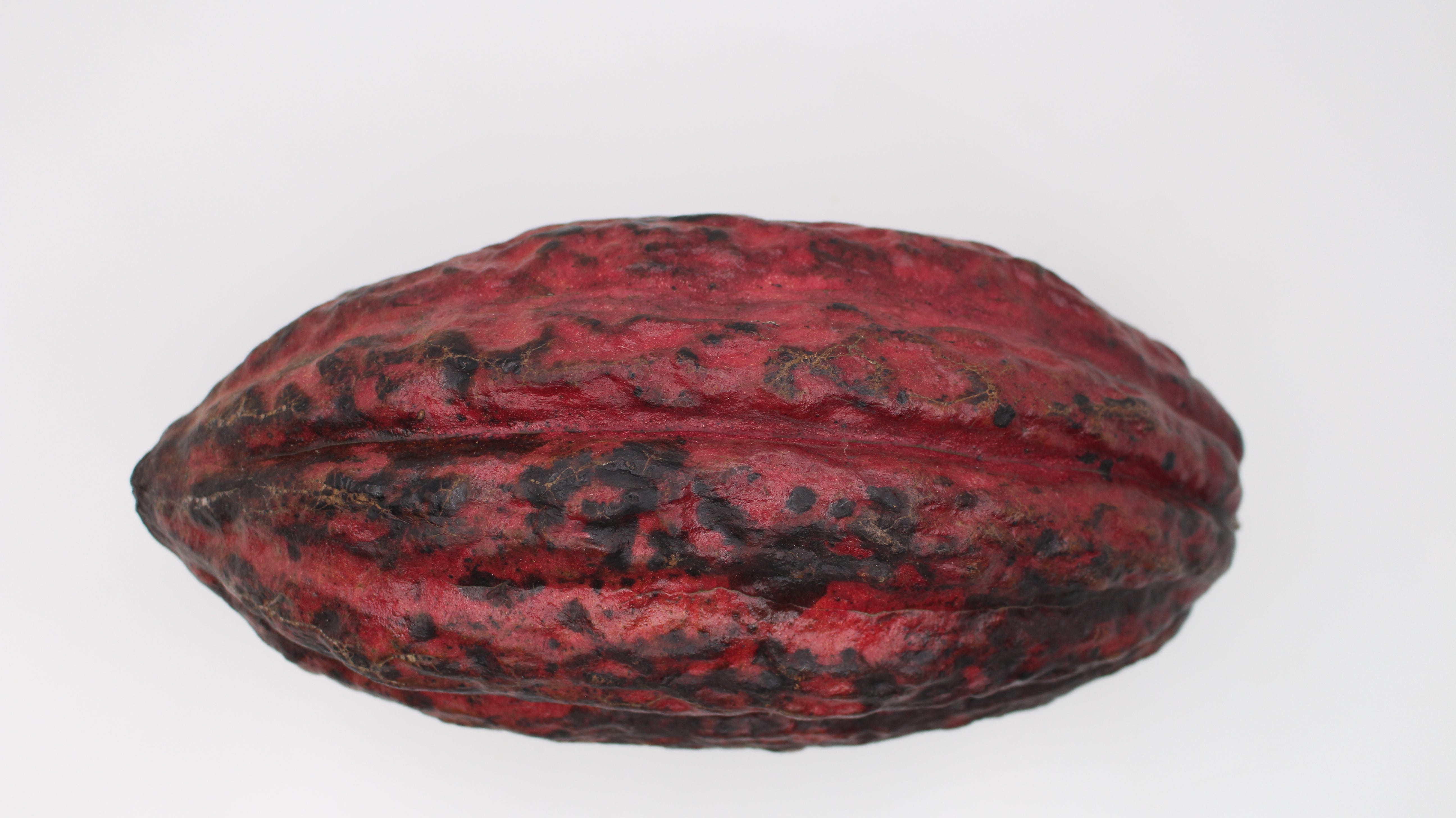
Then the geneticists arrived. To their credit they did not simply throw the old words away. They measured them.
In 2008, Juan Carlos Motamayor and colleagues genotyped 1,241 cacao trees from across the species’ range at 106 points in the genome and asked a computer, essentially, how many families are actually in here. The answer was not three. It was ten: Marañón, Curaray, Criollo, Iquitos, Nanay, Contamana, Amelonado, Purús, Nacional and Guiana.³ Most of them are named after rivers and towns in the upper Amazon, because that is where cacao comes from, and where most of its diversity still lives.
Criollo survived the audit. It is a real, distinct, measurable genetic group, one of the ten (so far). But the same work, and the work that followed, rearranged its biography in a way I find compelling.
Here is the short version, assembled from a few decades of papers: People in what is now Ecuador were using cacao about 5,300 years ago.⁴ Somewhere in that upper-Amazon world, a population of trees related to the group now called Curaray was taken into human hands. Around 3,600 years ago, by one genomic estimate, a small founding population, on the order of several hundred trees, ended up in Mesoamerica, and was domesticated there into the kakaw the Maya and their neighbors grew.⁵ That is Criollo. Born in Central America, of Amazonian blood. Criollo in exactly the colonial sense: from elsewhere by descent, from here by birth. Given criollo is a spanish word, the question that nags at me hardest is how, or if, the ancestral knowledge in mesoamerica translated accurately to an anthropogenetic description of the local adoption of a plant some 5,000 years before.
Did the planters who named it have a way of knowing how right they were? How would that knowledge have been translated into Spanish? Was it just an assumption made by the Spanish based on crude observations in their travels up the rivers of South America? Ultimately it is an epistemological mystery, which is the type of mystery I find endlessly fascinating.
But what this piece actually hinges on, aside from when and how criollo as a concept came to exist, is the prevalence of heterozygosity in most modern cacao genetics.
Cacao as a species is a shuffler. Most wild cacao carries two different versions of a great many of its genes, and many populations will not even pollinate themselves, so every seed is a new hand dealt from two decks. Plant the seed of a tree you love and you get its child, not its copy.
Criollo is the exception. It is one of the least heterozygous groups in the species, highly homozygous, inbred.⁶ Thousands of years of people keeping the trees they liked and planting their seeds, in a small population, narrowed the deck until it was mostly one suit. The 2018 genomic work that dated its domestication also found the bill for it: selection for flavor and the things people wanted came packaged with an accumulation of harmful mutations and lower yields.⁵ The very process that made Criollo predictably delicious made it weak.
So the revered one, the aristocratic scion of the chocolate world, the bean a whole luxury industry was built around, is a lineage that stopped shuffling. It is pale, aromatic, low in bitterness, low-yielding and famously susceptible to disease. When disease and economics came for it, the hardier, more heterozygous Amazonian material took over the plantations, and the hybrids took over the rest.⁷ Genuinely old, genuinely pure Criollo is rare now. Most of what wears the name in commerce has other ancestry mixed in.
When the first cacao genome was published in 2011, the tree sequenced was a Criollo from Belize.⁸ The family scion got its portrait painted first, because everyone wants to unlock its mysteries to aid in the betterment of cacao.
Three percent
At Agnes, we make chocolate in Colombia. We are focused on Colombian genetics, and supporting Colombian farmers who are personally invested in preserving their agricultural, agroforestal heritage.
In 2017 a team led by Jaime Osorio-Guarín worked through 565 trees held in the country’s national cacao gene bank and its breeding collection, the Colombia national library of cacao now held by Agrosavia.⁹ In the part of the collection they characterized chemically, the trees that came out as Criollo were about three percent. Those Criollo trees were genetically distinct, a group of their own, and most of them had been collected in the north: around the Serranía del Perijá and the Sierra Nevada de Santa Marta.
The same study found two genetic populations that didn’t match any of the ten reference groups. Colombia, the authors concluded, is not just a place where cacao grows. It is a center of cacao diversity in its own right.
Put those two findings next to the conversation I described at the top. A farmer in Huila, or Santander, or Tumaco tells me, with total conviction, that her trees are criollo. And the national gene bank suggests that, in the geneticist’s sense, the odds are against it, unless he happens to be farming in the right corner of the north. Meanwhile, the trees he does have may belong to populations that science has only just started naming.
The easy move here is to say the farmer is wrong. I would argue that she isn’t, she’s just using the folkloric definition. She is identifying tradition.
It was here when we got here
To a great many people across Latin America, criollo does not refer to a specific genetic cluster published in a 2008 PLOS ONE journal paper. It means something closer to: it was here when we got here. Mi bisabuelo sembró las primeras matas. My great-grandfather planted the first plants. Or it is from before my great grandfather. It is the tree that predates the deed to the land. It is even more native to here than I am (which, as a gringo making chocolate in Manizales, is a bar the tree clears easily).
This is, almost exactly, the original colonial meaning of the term. Born here. Not genetically pure, not descended from the Maya. Here before the rest of us, and from here in the way that only time makes something from anywhere.
And here is why I think this folkloric concept of criollo says more about terroir than the chapter I was supposed to be adapting:
The wine version of terroir, the Burgundy version, holds the grape constant and lets the place vary. Same Pinot Noir, two slopes, two wines. Place as a modifier. That’s real, and in cacao it’s measurable, and that is what the book chapter proves. But it treats the plant as a fixed thing that the place merely acts upon.
Now think about how a folk criollo actually came to exist. A family plants seed, not grafts, because seed is free and grafting is a skill, a relatively new skill, at least in cacao, and a cost. The seed comes from their own trees or the neighbor’s. Cacao being the shuffler it is, every seedling is a little different from its parents. Some die. Some get sick in the wet months. Some make pods that rot before they ripen; some make pods that the kids raid for the pulp because it tastes like candy (anthropogenic seed dispersion, mind you). Over decades, or centuries, the family cuts down the trees that disappoint them and saves seed from the ones that don’t, not with a spreadsheet but with a machete and a memory. The soil, the rain, the fungus that lives in that particular valley, the altitude, the whims of the people doing the choosing: all of it is filtering the deck, every generation, for hundreds of years.
What comes out the other end is what plant people call a landrace10, and what the family calls criollo. And it is terroir in a sense far deeper than Burgundy’s. The place didn’t just season the plant, it wasn’t just extra sugar from the sunny side of the hill or extra iron from that patch of soil. On this timescale, and with these genetics, the place created the plant. The genetics are the terroir, accumulated, the way a riverbed is the river’s history written in stone.
This is what’s so extraordinary about cacao specifically. An often heterozygous, outcrossing species grown from seed by informal, traditional, artisanal hands is a machine for turning a place and the people who live there into genotypes and phenotypes of extraordinary value. Criollo in the scientific sense is what that machine produced in Mesoamerica, over thousands of years, until it narrowed to near-perfect, fragile consistency. Criollo in the folk sense is the same machine, running right now, on ten thousand hillsides and their valleys, still shuffling.
Magnificent and terrible
I would love to tell you that this makes folk criollo a guarantee of greatness. It does not. Nothing about cacao is a guarantee of greatness, which is most of what makes it interesting.
Within both contexts, the measured Criollo and the folkloric one, there are terrible beans and magnificent beans. There are pulps that taste like candy, and there are pulps that taste like a bad apple, the mealy one at the bottom of the bag. A machine that turns a place into a genotype doesn’t necessarily care whether the genotype is delicious. It cares whether the tree survived and whether somebody wanted to keep it, and people keep trees for all kinds of reasons.
So you get every combination:
Criollos grown for tradition, not flavor. The tree stays because Grandpa planted it, and you do not cut down Grandpa’s tree. I find it hard to argue with this, as a value system, even when the beans are mediocre. Especially then, maybe. It should be noted this is a sentimentalism that geneticists and agronomists find appalling, in my experience.
Folkloric criollos that are true, one hundred percent Criollo. They exist. Somebody’s great-grandfather was right, and the DNA agrees with him.
Criollos sworn to be one hundred percent that are zero percent Criollo. Sworn sincerely, I want to stress. Nobody is lying. They’re answering a question about history, and you’re thinking of a question about genetics. Nuestro criollo. Our criollo.
And some of those zero percent criollos are mindblowing. Some of the best cacao I have tasted came from trees that a lab would never call Criollo and a family would never call anything else.
There does appear to be some correlation between pulp flavor and cacao flavor. Fundación San Vicente #41 is well known for the deliciousness of its pulp. There are a few entrepreneurs in Colombia taking advantage of it as a byproduct of their cocoa production. It is zingy, acidic, fruity, complex and lingering. It is uncannily similar to shoving a small handful of Sourpatch Kids in your mouth all at once. I mean that in the best, most nostalgic sense possible.
Federación Arauquita #5 is a close second. Third is one that may surprise you, as the chocolate literature (the blogosphere or what have you) tells you ad nauseum that Colección Castro Naranjal #51 is inferior in every way but yields. Yes, the infamous CCN-51 has one of the most delicious pulps of any fruit God has graced the earth with. And from what we know, good pulp should mean good beans. FSV-41 and FEAR-5 make many of the best, most award winning chocolates commercially available today. FSV-41 is notorious for being highly encriollado, or made criollo, through hybridization.
I’ll tell you what I initially thought this meant, and how I found out I was right. First, I thought that CCN-51 must have a lot of potential to make premium chocolate (lets ignore the fact that “premium chocolate” is largely a scam and relies primarily on a lack of marketing rules for now). And second, first by accident, then by testing.
I knew that CCN-51 could be great, in my heart of hearts. Years ago I bought a single kilogram of beans from a roadside stand in front of clearly CCN-51 loaded trees, giant, deep-red mauve mazorcas packed onto trees by the hundred, along the road in Pauna, Boyacá. I roasted them at 180ºC (which I had read was necessary to kill bacteria, and is actually a major disservice to cacao, but more on that another day) in a coffee roaster (not the correct tool) and then peeled them by hand. I made 72% chocolate in a stone mill that I ran for 3 days. The result, to be concise, had me wrap the bar in plastic and put a skull and crossbones on it to never eat again. It was horrifically acidic, not pleasantly, it had an astringency that lingered seemingly for days, like a hangover from witch hazel schnapps. I forgot about it deep in the kitchen pantry.
About 18 months later I stumbled across it again. I reluctantly tried it, remembering what I once read in the Dandelion Chocolate book about age having a mysterious effect on a lost pallet of Venezuelan beans. I would not say the result was magical, but it was meaningful. I now knew, through other investigations, that these beans came with defects: oversaturated and not enough oxygen during fermentation, and probably took several weeks to dry, or was dried directly on asphalt (possibly both, first one, then the other).
CCN-51, it turns out, has too much pulp. Too much sugar and too much liquid from this excess in pulp means fermentation rarely goes to plan using traditional methods. Many farmers now know that you have to wring it out, scrape it off or press it, which makes the increased yields seem less impressive. Combine this excess pulp with a rainy season, and trouble lies ahead. Most farmers do not have access to mechanical dryers, fans, solar installations, or even a well-constructed drying facility of any kind. The majority of farms who ferment onsite use plastic, metal, or MDF wood as tables covered in corrugated plastic or metal roofs or sometimes just a tarp, often wind damaged and precariously adjusted.
But this chocolate, which started out tasting like poison, while not necessarily delicious, became palletable. Soft citrus and sour pineapple notes. The astringency had gone almost completely. What was left was something that, with a few small tweaks to its regimen, would have been one of the most unique chocolates ever produced.
So we took it to the lab. We toasted CCN-51 beans from all over Colombia at temperatures ranging from 110ºC to 170ºC, from at little as 10 to as long as 45 minutes. Then we ground it (we only use stone mills in the shop), sometimes we added heat and a fan to simulate a conch. Sometimes we ground for 2 days, sometimes for 4. Sometimes we stopped at 50 microns, sometimes at 15.
The results are why I am still fascinated by chocolate every day, and why every cup of chocolate I drink every morning (yes, every morning) is a journey to a place and time. Today we have CCN-51 from three different regions in the shop. Calamar, Guaviare, Landazuri, Santander, and Tumaco, Nariño. We are certain of the genetics, though some other genetics, the folkloric criollos especially, were likely mixed in. We are certain that the fermenters of these beans knew you had to cut some pulp, giving the beans their best chance to shine. What we couldn’t know, but what we will know in future batches: how was the weather? What is the altitude? How many days to ferment? What is the canopy cover? What is the soil composition?
Those variables are some of why the three CCN-51 chocolates on the shelves taste wildly different. That is the slow motion, post-harvest terroir of a place. Now, multiply that by a heterozygous genebank, limitless curiosity of the farmers, and thousands of different microclimates of Colombia, Peru and Venezuela, and you start to have a picture of the limitless complexity, and limitless possibilities, of real chocolate as an ingredient. It is orders of magnitude more complex than wine, which people can and will opine over relentlessly when given the opportunity. There are entire geographical regions dedicated to wine (usually in abhorrent monoculture, but that’s another post), tours and hotels and airports dedicated to exploring those regions; people celebrate their most intimate life moments in front of temples designed for just tasting it…alas, chocolate is not there yet. It will be.
But If you’re looking for a lesson here, though I may advise against it given my biases, there are two: first, that the words on a label tell you almost nothing about what’s in the bar, in any direction. Criollo on a wrapper might mean a measured genotype, an inherited story, a marketing department’s fever dream, or all three. Each of those can sit on top of a bean that’s sublime or a bean that’s flat, or a bean treated industrially or with artisan hands. You find out by buying–because that’s all the seller cares about–and then tasting.
The second lesson is that industrial processing rubrics are basically meaningless in the world of artisan chocolate. They are designed to flatten and eliminate character. In the case of CCN-51, the character is both overpowering (acidic) and then, once processed, flat. But the problem is not the bean. It is the process itself.
Such is the wholly underappreciated reality of cacao in the Americas. It’s not three families you can just program into your thousand ton per day production line. It isn’t even ten families. It’s ten genetic clusters (so far) plus five thousand-plus years of people, plus every hillside those people ever planted seed on, and their competition across the valley, plus whatever they decided was worth keeping, for whatever reason. It’s a largely unregulated product that people can claim, honestly or cynically, whatever they damn-well please about it. But given the amount of passion in the current artisan movement, and the dedication of cacao farmers across Colombia and elsewhere to preserve their heritage, it won’t be like that forever.
So what’s a chocolate maker do
Here’s where I have to stop being a curious person and start being a person who sells chocolate, and I want to be upfront about that shift, because the whole problem with criollo as a commercial word is that it has been used by people who didn’t make that shift visible.
The word sells. It has sold for centuries. Put it on a wrapper and the price goes up, regardless of what’s inside, because a century of chocolate books told people it means the best. Which leaves an honest maker with two bad options: use the word and inherit its ambiguity, or refuse the word and give up a story that, in its folk sense, is often completely true.
Our answer at Agnes is to make the word do less work and the specifics do more.
We don’t lean on criollo as a quality claim. We name the farm and the harvest year instead, which is why our single-origin bars say Cacao Agroforestal de Origen and then tell you exactly where. We taste the pulp at the tree, because the pulp tells you a lot about what the bean might become. We keep lots separate instead of pooling them, because a hillside’s character doesn’t survive being mixed with forty others: differentiation, in industry parlance. We ferment where the cacao grows, because the yeasts and bacteria that do the fermenting are part of the place too. And we don’t add vanilla, because vanilla is how you paper over a bean you’re not proud of. (Unless of course it’s milk chocolate, especially when we make it with a regional criollo from Tumaco which happens to taste like burnt cream and buttered toast, in which case, the vanilla goes in. (The vanilla, btw, is wild vanilla from Tumaco and Chocó, and we sell it on our website)).
When we know a tree’s genetics, we’ll say so. When the honest answer is the family says it’s criollo, the lab hasn’t weighed in, and it tastes like this, we’ll say that, we call it regional criollo. I’d rather hand you a true sentence with a question mark in it than a clean one that isn’t true.
There’s a small irony I enjoy here. Even Colombia’s modern bred selections, the ones that come out of research programs with serial numbers, tend to be named after where they came from: Federación Arauquita #5, Fundación San Vicente #41. Even lab trees can’t escape being from somewhere.
I’ll get back to the terroir chapter. The Burgundian monks will keep, and so will the Trinidad study. They make a good case that place changes how a bean tastes.
But I think the farmer’s look, the one you’d give someone who asked how you know your grandmother is your grandmother, makes a better one. It says that place doesn’t only season the tree. Over enough generations of seed and choice and weather, place becomes the tree. That’s what criollo has always meant to the people who use the word without footnotes. It was here when I got here. It’s from here in a way I’ll never be. And if we do our jobs, it’ll still be here after.
The taste of place isn’t only what the soil and the rain do to cacao. It’s who kept which seed, and why. And as chocolate makers, our job is to highlight and preserve that heritage.
— TF
[Subscribe button] · Films coming soon on YouTube at @aboutchocolate · Archive at agneschocolates.com/blog
Notes
¹ A heterozygous plant carries two different versions of many of its genes, one from each parent. Its seeds are a reshuffle of both. That’s why a cacao seed from a great tree is a lottery ticket and a graft from the same tree is a photocopy.
² Under the colonial casta system, criollos ranked below people born in Spain and above almost everyone else. That the chocolate world’s highest compliment is a colonial caste term is worth an essay of its own. This isn’t that essay, but I notice it.
³ My favorite detail in the paper is in the abstract: before finding its ten clusters, the team had to throw out the mislabeled samples. Even the world’s gene banks have the criollo problem.
⁴ Residues and starch grains on pottery from Santa Ana-La Florida, in southern Ecuador’s Mayo-Chinchipe culture, push human use of cacao back about 5,300 years, roughly 1,500 years earlier than the previous Mesoamerican evidence (Zarrillo et al., 2018).
⁵ Cornejo et al., 2018. They estimate a single domestication around 3,600 years ago from a founding population of roughly 738 trees (somewhere between about 440 and 2,700), descended from a population related to Curaray. Exactly where the process began is still argued about. An earlier study (Motamayor et al., 2002) had already traced the Maya’s cacao back to South American roots.
⁶ Motamayor et al. (2008) describe the traditional cultivars, Criollo among them, as highly homozygous, far less varied than wild Amazonian populations.
⁷ The usual telling has a crop failure in Trinidad in 1727, replanting with Amazonian material, and the resulting crosses giving us trinitario. The details are debated.
⁸ Argout et al., 2011. The tree was a Belizean Criollo.
⁹ Osorio-Guarín et al., 2017. The collection was held by Corpoica, now Agrosavia. The roughly three percent figure comes from the part of the collection they classified chemically, using the ratio of theobromine to caffeine.
¹⁰ A landrace is a population adapted to one place and kept by traditional, informal selection rather than formal breeding. It’s genetically varied on purpose, or rather on no purpose at all, which is the point.
Sources
Motamayor, J.C. et al. (2008). Geographic and genetic population differentiation of the Amazonian chocolate tree (Theobroma cacao L). PLOS ONE 3(10): e3311.
Cornejo, O.E. et al. (2018). Population genomic analyses of the chocolate tree, Theobroma cacao L., provide insights into its domestication process. Communications Biology. WSU summary
Osorio-Guarín, J.A. et al. (2017). Colombia a source of cacao genetic diversity as revealed by the population structure analysis of germplasm bank of Theobroma cacao L. Frontiers in Plant Science 8: 1994.
Argout, X. et al. (2011). The genome of Theobroma cacao. Nature Genetics 43: 101–108.
Motamayor, J.C. et al. (2002). Cacao domestication I: the origin of the cacao cultivated by the Mayas. Heredity 89: 380–386.
Zarrillo, S. et al. (2018). The use and domestication of Theobroma cacao during the mid-Holocene in the upper Amazon. Nature Ecology & Evolution 2: 1879–1888.